Luža Square
Stradun ends at its far east in Luža Square, where some of Dubrovnik's most important monuments lie.
Luža Square is Dubrovnik's most important square. Historically, the walled city's market was found in this square, at the far east of Stradun. Thanks to the numerous historical buildings surrounding the square, Luža reflects the architectural splendour of Dubrovnik.
What to See in Luža
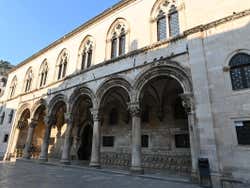
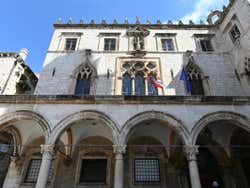
In Luža Square, you can find Rector's Palace, Sponza Palace, Dubrovnik Cathedral, City Hall and Saint Blaise Church. Plus, you can also find monuments such as Orlando's Column and Onofrio's Small Fountain, the smaller sister of Onofrio's Big Fountain.
Orlando's Column
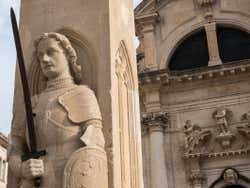
At the beginning of the 15th century, the inhabitants of Dubrovnik woke up to a stone statue of a medieval knight presiding over the centre of Luža Square. This figure soon became known as Orlando's Column and a symbol of freedom in Ragusa and of the republic's independence.
According to legend, Orlando was a brave knight who saved Dubrovnik from invasion by the Arabs. The figure holds a sword and shield with the Croatian flag. Main events, important announcements and public punishments happened here, and today it's still one of the main meeting points in the city.
What's more, Orlando's Column was key for business in the Old Republic of Ragusa, since it served as a measuring standard for the city. The knight's forearm was used as a unit of measurement, and the column's footmark was also used to measure goods.
The Clock Tower
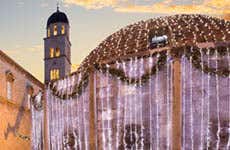
The Clock Tower in Luža Square is one of the most symbolic monuments of Stradun Street. Each hour on the dot, the bells ring all throughout the city thanks to Maro and Baro, the two men in charge of doing so.
Today, the original statues of these bells, called zelenci in Croatian, are found in the Rector's Palace museum. This historic bell tower tells the time in Roman numerals and has a beautiful sundial.
Church of Saint Blaise
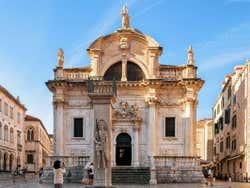
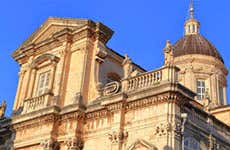
In the centre of Luža Square, you can find the church of the city's patron saint: Saint Blaise. It's a beautiful temple in the Venetian-Baroque style, built over an old Roman church.
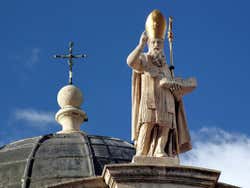
After the 1667 earthquake and subsequent fire, Saint Blaise Church was totally destroyed and only a small statue of Saint Blaise was saved. This now can be found above the entrance. Thanks to the model of the city that the saint is holding in his hand, we can know what the ancient city of Dubrovnik looked like in the 15th century.
Entry to Saint Blaise Church is free.